
What Are Adverbs in English Grammar?
Adverbs in English grammar are words that give more information about verbs, adjectives, or other adverbs. They tell us how, when, where, how often, or to what extent something happens. Adverbs make sentences clearer and more meaningful.
For example:
- She speaks clearly.
- He arrived early.
- The train is very fast.
In this complete guide on adverbs in English grammar, you will learn the definition, types, rules, examples, common mistakes, and easy learning tips. This article is written in simple English and is perfect for school students, exam aspirants, and English learners.
What Is an Adverb? (Simple Definition)
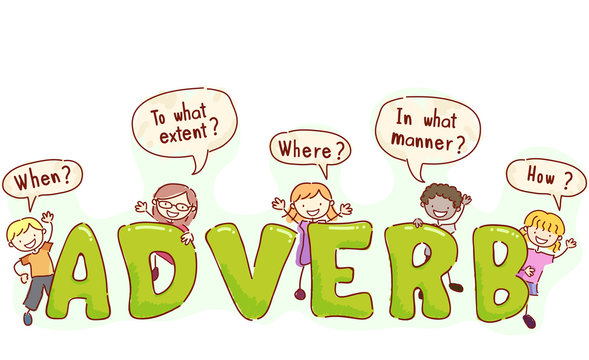
An adverb is a word that modifies or describes a verb, an adjective, or another adverb.
It answers questions like:
- How?
- When?
- Where?
- How often?
- How much?
Examples:
- He runs quickly.
- She is very happy.
- They arrived yesterday.
Understanding adverbs in English grammar helps improve both speaking and writing skills.
Why Are Adverbs Important in English?
Adverbs help us:
- Add details to actions
- Express time, place, manner, frequency, and degree
- Make communication clear and effective
Compare:
- He speaks English.
- He speaks English fluently.
The second sentence sounds more complete because of the adverb.
Types of Adverbs in English Grammar
There are different types of adverbs in English grammar. Let us learn each type with simple explanations and examples.
1. Adverbs of Manner
Adverbs of manner tell us how an action happens.
Examples:
- She sings sweetly.
- He works hard.
- The child slept peacefully.
Most adverbs of manner end in -ly, but not all.
2. Adverbs of Time
Adverbs of time tell us when an action happens.
Examples:
- I will call you tomorrow.
- She came late.
- We met yesterday.
They are very common in daily English.
3. Adverbs of Place
Adverbs of place tell us where an action happens.
Examples:
- Come here.
- The children are playing outside.
- He looked everywhere.
4. Adverbs of Frequency
Adverbs of frequency tell us how often an action happens.
Examples:
- I always wake up early.
- She often reads books.
- He never tells lies.
Common adverbs of frequency: always, usually, often, sometimes, rarely, never
5. Adverbs of Degree
Adverbs of degree tell us how much or to what extent something happens.
Examples:
- She is very tired.
- The water is too hot.
- I am quite satisfied.
They are used mainly with adjectives and adverbs.
6. Interrogative Adverbs
Interrogative adverbs are used to ask questions.
Examples:
- When will you come?
- Where do you live?
- How did you solve this problem?
7. Relative Adverbs
Relative adverbs introduce relative clauses.
Examples:
- This is the place where I was born.
- That was the day when we met.
Common relative adverbs: where, when, why
Formation of Adverbs in English Grammar
Many adverbs are formed by adding -ly to adjectives.
Examples:
- slow → slowly
- quick → quickly
- careful → carefully
Spelling Rules:
- happy → happily
- true → truly
But some adverbs do not end in -ly:
- fast
- hard
- well
Position of Adverbs in a Sentence
Adverbs in English grammar can appear in different positions.
1. Beginning of a sentence
- Yesterday, I met him.
2. Middle of a sentence
- She often visits us.
3. End of a sentence
- He spoke politely.
Correct placement makes sentences sound natural.
Adverbs of Frequency: Special Rule
Adverbs of frequency usually come:
- Before the main verb
- After the verb ‘to be’
Examples:
- She always helps me.
- He is never late.
Comparison of Adverbs
Like adjectives, adverbs also have degrees of comparison.
Examples:
- fast – faster – fastest
- carefully – more carefully – most carefully
- well – better – best
Common Mistakes with Adverbs
Avoid these errors:
❌ She speaks English very good. ✔ She speaks English very well.
❌ He runs quick. ✔ He runs quickly.
Learning correct adverbs in English grammar improves accuracy.
Adverbs vs Adjectives (Simple Difference)
| Adverbs | Adjectives |
| Describe verbs, adjectives, adverbs | Describe nouns |
| He runs fast | He is a fast runner |
Understanding this difference is very important.
Easy Tips to Learn Adverbs in English Grammar
- Read simple English sentences daily
- Notice words ending with -ly
- Practice speaking with adverbs
- Learn common adverbs by heart
- Use adverbs in writing exercises
Practice Exercise on Adverbs
Fill in the blanks:
- She completed the work ______. (careful / carefully)
- He is ______ late for class. (often / usual)
- The baby slept ______. (peaceful / peacefully)
Importance of Adverbs for Exams and Daily English
Adverbs in English grammar are important for:
- School and board exams
- Competitive examinations
- Spoken English fluency
- Writing essays and stories
Strong command of adverbs helps students score better marks.
Adverbs in English grammar help us express actions clearly and accurately. By learning the types, formation, position, and correct usage of adverbs, you can greatly improve your English communication skills.
Practice regularly, observe adverbs in daily use, and slowly your English will become fluent and confident.
Leave a Reply