
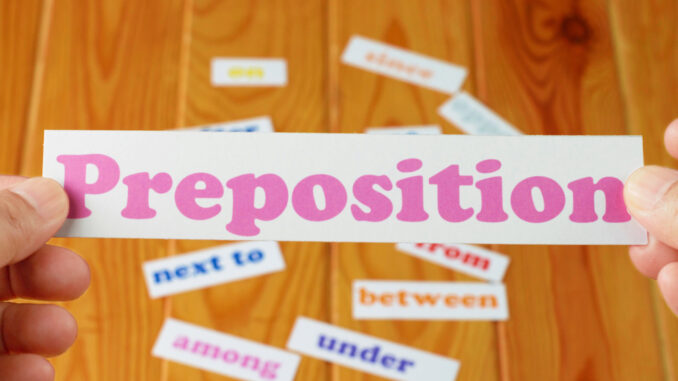
Prepositions are one of the most important parts of English grammar. Many learners feel confused while using them, but once you understand the basics, prepositions in English become easy and natural. A small mistake in a preposition can change the meaning of a sentence completely. That is why learning prepositions properly is essential for speaking, writing, and examinations.
This blog post explains prepositions in English in a simple, clear, and human-written style. It is perfect for school students, competitive exam aspirants, and anyone who wants to improve daily spoken and written English. You will learn the definition, types, rules, common mistakes, and plenty of examples. At the end, you will also find practice multiple-choice questions to test your understanding.
What Are Prepositions?
A preposition is a word that shows the relationship between a noun or pronoun and another word in a sentence. It usually tells us about place, time, direction, movement, or manner.
Simple Definition
A preposition tells us where, when, or how something happens.
Examples:
- The book is on the table.
- She came after lunch.
- He is waiting for his friend.
In these sentences, the words on, after, and for are prepositions.
Why Prepositions in English Are Important
Learning prepositions in English is important because:
- They make sentences clear and meaningful
- They improve spoken English fluency
- They are frequently asked in school and competitive exams
- They help in writing accurate sentences
Without correct prepositions, English sounds unnatural and confusing.
Types of Prepositions in English
There are different types of prepositions in English based on their usage. Let us understand them one by one.
1. Prepositions of Place
Prepositions of place tell us where something is.
Common Prepositions of Place:
- in
- on
- at
- under
- behind
- between
- among
- above
- below
Examples:
- The cat is under the chair.
- She lives in Chennai.
- The picture is on the wall.
In, On, At (Place)
- In – used for enclosed spaces (room, city, country)
- On – used for surfaces
- At – used for specific points
Examples:
- He is in the room.
- The keys are on the table.
- She is at the bus stop.
2. Prepositions of Time
Prepositions of time tell us when something happens.
Common Prepositions of Time:
- at
- on
- in
- before
- after
- during
- since
- for
In, On, At (Time)
- At – exact time (at 6 a.m.)
- On – days and dates (on Monday)
- In – months, years, long periods (in July)
Examples:
- The class starts at 9 o’clock.
- My birthday is on Sunday.
- She was born in 2010.
3. Prepositions of Direction and Movement
These prepositions show movement from one place to another.
Common Prepositions of Movement:
- to
- into
- onto
- towards
- across
- through
- along
Examples:
- She is going to school.
- The boy jumped into the river.
- We walked across the road.
4. Prepositions of Manner and Means
These prepositions show how something is done or by what means.
Common Prepositions:
- by
- with
- in
Examples:
- She wrote the letter with a pen.
- The news was announced by the teacher.
- He spoke in a loud voice.
5. Prepositions Used with Nouns, Verbs, and Adjectives
Some prepositions in English are commonly used with specific nouns, verbs, and adjectives.
With Verbs:
- depend on
- believe in
- listen to
Examples:
- I depend on my parents.
- She believes in hard work.
With Adjectives:
- afraid of
- good at
- interested in
Examples:
- He is afraid of dogs.
- She is good at maths.
Common Mistakes in Using Prepositions
Learners often make mistakes while using prepositions in English. Let us look at some common errors.
❌ She discussed about the issue.
✔ She discussed the issue.
❌ He entered into the room.
✔ He entered the room.
❌ She is married with a doctor.
✔ She is married to a doctor.
Easy Tips to Learn Prepositions in English
- Learn prepositions in phrases, not alone
- Read simple English sentences daily
- Practise writing short sentences
- Notice prepositions while listening to English
Regular practice is the key to mastering prepositions in English.
Practice Exercises: Multiple Choice Questions
Choose the correct preposition.
- The book is ___ the table. (a) in (b) on (c) at (d) by
- She was born ___ 2012. (a) on (b) at (c) in (d) for
- The train arrives ___ 6 p.m. (a) in (b) on (c) at (d) during
- He is afraid ___ snakes. (a) from (b) with (c) of (d) by
- We walked ___ the bridge. (a) across (b) under (c) between (d) among
- She is good ___ English. (a) in (b) at (c) of (d) for
- The children are playing ___ the park. (a) on (b) at (c) in (d) by
- He went ___ the room quietly. (a) into (b) onto (c) to (d) in
- The meeting is ___ Monday. (a) in (b) at (c) on (d) for
- This gift is ___ you. (a) to (b) for (c) with (d) by
Understanding prepositions in English is essential for correct grammar and clear communication. Though they seem small, prepositions play a big role in sentence meaning. With simple explanations, clear examples, and regular practice, anyone can master prepositions. Keep practising daily, and soon using prepositions in English will become natural and easy for you.
Leave a Reply