
Introduction to Prefix and Suffix in English
Learning English vocabulary becomes much easier when you understand prefix and suffix in English with examples. Prefixes and suffixes help you guess the meaning of new words, improve spelling, and expand your vocabulary quickly.
Many English learners struggle with long or unfamiliar words. But once you know how prefixes and suffixes work, you can break words into parts and understand them easily. That is why prefixes and suffixes are taught in schools, grammar books, and competitive exams.
This article explains prefix and suffix in simple English, with clear examples, lists, rules, and practice tips. It is perfect for students, beginners, ESL learners, and exam candidates.
What Is a Prefix?
A prefix is a group of letters added before the root word to change its meaning.
Definition of Prefix
A prefix is a word part added at the beginning of a word to change its meaning.
Examples of Prefix
- Un + happy = unhappy
- Re + write = rewrite
- Dis + honest = dishonest
In all these examples, the prefix changes the meaning of the base word.
What Is a Suffix?
A suffix is a group of letters added at the end of a word to change its meaning or grammatical form.
Definition of Suffix
A suffix is a word part added at the end of a word to change its meaning or function.
Examples of Suffix
- Happy + ness = happiness
- Teach + er = teacher
- Quick + ly = quickly
Understanding prefix and suffix in English with examples helps learners form many new words from one root word.
Difference Between Prefix and Suffix
| Prefix | Suffix |
| Added at the beginning | Added at the end |
| Changes meaning | Changes meaning or grammar |
| Example: unhappy | Example: happiness |
Both prefixes and suffixes play an important role in English word formation.
Why Are Prefix and Suffix Important in English?
Learning prefix and suffix in English with examples helps you:
- Understand new words easily
- Improve vocabulary
- Guess meanings without a dictionary
- Write correct English
- Perform better in exams
Prefixes and suffixes are commonly used in academic English, spoken English, and competitive exams.
Common Prefixes in English with Meanings and Examples
Below is a list of common prefixes in English that are frequently used.
1. Un- (not)
- Unhappy – not happy
- Unkind – not kind
2. Re- (again)
- Rewrite – write again
- Reuse – use again
3. Dis- (not / opposite)
- Disagree – not agree
- Dishonest – not honest
4. Pre- (before)
- Prepaid – paid before
- Preview – see before
5. Mis- (wrongly)
- Misunderstand – understand wrongly
- Misbehave – behave badly
These examples clearly show prefix and suffix in English with examples in real use.
Common Suffixes in English with Meanings and Examples
Let us now look at some common suffixes in English.
1. -ness (state or quality)
- Kindness
- Happiness
2. -er (person who does an action)
- Teacher
- Writer
3. -ly (manner)
- Slowly
- Clearly
4. -ment (result or action)
- Development
- Improvement
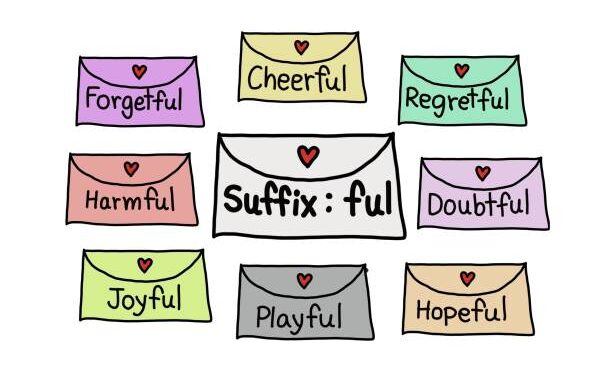
5. -ful (full of)
- Helpful
- Beautiful
Suffixes help us identify nouns, verbs, adjectives, and adverbs easily.
Prefix and Suffix List for Beginners
Here is a simple prefix and suffix list for beginners.
Prefix List
| Prefix | Meaning | Example |
| Un- | Not | Unfair |
| Re- | Again | Rewrite |
| In- | Not | Incorrect |
| Over- | Too much | Overeat |
| Under- | Less | Underpaid |
Suffix List
| Suffix | Meaning | Example |
| -er | Person | Teacher |
| -ness | State | Kindness |
| -ful | Full of | Useful |
| -less | Without | Careless |
| -ly | Manner | Quickly |
This list makes learning prefix and suffix easily for beginners.
How Prefix and Suffix Change Word Meaning
Prefixes and suffixes can completely change the meaning of a word.
Example with Prefix:
- Agree → Disagree
- Possible → Impossible
Example with Suffix:
- Help → Helpful
- Beauty → Beautiful
This is why understanding prefix and suffix in English with examples is very important.
Prefix and Suffix Rules You Should Know
Here are some basic rules to remember:
Rule 1: Prefixes Do Not Change Word Form
They only change meaning.
Example:
- Happy (adjective) → Unhappy (adjective)
Rule 2: Suffixes Can Change Word Form
They can change nouns to adjectives or verbs to nouns.
Example:
- Teach (verb) → Teacher (noun)
Rule 3: Spelling May Change Slightly
Sometimes spelling changes when adding suffixes.
Example:
- Happy → Happiness
- Easy → Easily
Common Mistakes with Prefix and Suffix
Many learners make these mistakes:
Wrong:
❌ He is unpossible to come.
Correct:
✅ He is impossible to come.
Wrong:
❌ She speaks quick.
Correct:
✅ She speaks quickly.
Practising prefix and suffix in English with examples helps avoid these errors.
Prefix and Suffix in Exams
Questions on prefixes and suffixes appear in:
- School exams
- SSC, PSC, Bank exams
- Competitive English tests
- Vocabulary sections
Example Question:
Choose the correct word:
She is a very ___ person.
a) kindness
b) kind
c) kindly
✔ Correct answer: kind
Easy Tips to Learn Prefix and Suffix
Here are some simple learning tips:
- Learn common prefixes and suffixes daily
- Break words into parts
- Make your own examples
- Practice writing sentences
- Read English books regularly
These methods help you learn prefix and suffix easily.
Practice Exercise: Prefix and Suffix
Fill in the blanks:
- He is very ___ (help + ful / help + less).
- Please ___ the letter. (re + write / un + write)
- She spoke ___ (slow + ly / slow + ness).
Answers:
- helpful
- rewrite
- slowly
Benefits of Learning Prefix and Suffix in English
Learning prefix and suffix in English with examples helps you:
- Build strong vocabulary
- Improve spelling
- Understand meanings faster
- Speak and write confidently
- Score better in exams
Prefixes and suffixes are powerful tools in English. They help learners understand thousands of words by learning just a few word parts. By mastering prefix and suffix in English with examples, you can improve your vocabulary, grammar, and confidence in English. Practice regularly, revise lists, and use prefixes and suffixes in your daily writing. Over time, English will become much easier and more enjoyable.
Leave a Reply