
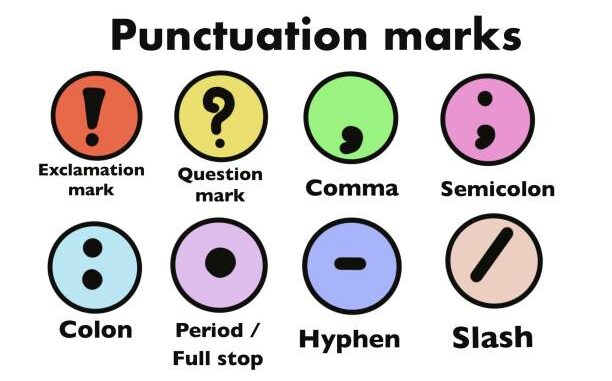
Why Punctuation Marks Matter in English
Punctuation marks are small symbols, but they play a big role in English writing. They help readers understand meaning, emotion, and structure. Without punctuation, sentences can become confusing or even change meaning completely.
For students, teachers, bloggers, and competitive exam aspirants, learning punctuation marks in English with examples is essential. Correct punctuation improves writing clarity, boosts exam scores, and makes your English look professional.
In this detailed guide, you will learn all major punctuation marks, their rules, clear examples, and common mistakes. The language is simple, practical, and easy to understand—perfect for beginners and intermediate learners.
What Are Punctuation Marks?
Punctuation marks are symbols used in writing to separate sentences, clauses, and ideas. They guide the reader on how to read a sentence, where to pause, stop, or express emotion.
In English, punctuation helps to:
- Show sentence boundaries
- Clarify meaning
- Express emotions and tone
- Avoid ambiguity
- Improve readability
Let us now learn the most important punctuation marks in English with examples.
1. Full Stop (.) – The Period
Use of Full Stop
A full stop is used at the end of a declarative sentence. It shows that the sentence is complete.
Rules of Full Stop
- Use it at the end of statements
- Use it after abbreviations (in British English, some abbreviations may not use it)
Examples
- I like learning English.
- She is a teacher.
- Dr. Abdul Kalam was a great leader.
Common Mistake: Do not use a full stop after questions or exclamations.
2. Comma (,) – The Pause Maker
Use of Comma
A comma shows a short pause in a sentence. It separates ideas and items.
Rules of Comma
- To separate items in a list
- After introductory words
- Before conjunctions like and, but, so
- To separate clauses
Examples
- I bought apples, oranges, and bananas.
- After school, he went home.
- She tried hard, but she failed.
Learning comma usage is a key part of mastering punctuation marks in English with examples.
3. Question Mark (?)
Use of Question Mark
A question mark is used at the end of a direct question.
Examples
- What is your name?
- Where are you going?
- Do you like English grammar?
Tip: Indirect questions do not take a question mark.
- I asked where he was going.
4. Exclamation Mark (!)
Use of Exclamation Mark
An exclamation mark shows strong feelings like happiness, surprise, anger, or excitement.
Examples
- Wow! That is amazing!
- Help! Someone is calling me.
- What a beautiful day!
Avoid Overuse: Too many exclamation marks make writing look unprofessional.
5. Apostrophe (’)
Use of Apostrophe
The apostrophe has two main uses:
- To show possession
- To form contractions
Examples of Possession
- This is Rahim’s book.
- The girl’s bag is red.
Examples of Contractions
- Don’t (do not)
- I’m (I am)
- She’s (she is)
Correct apostrophe usage is very important in punctuation marks in English with examples.
6. Quotation Marks (“ ”)
Use of Quotation Marks
Quotation marks are used to show direct speech or quotations.
Examples
- She said, “I am happy today.”
- The teacher said, “Be punctual.”
Single Quotation Marks (‘ ’)
Used inside quotations or in British English.
- He said, ‘I heard her say “hello”.’
7. Colon (:) – The Introducer
Use of Colon
A colon introduces explanations, lists, or examples.
Examples
- Bring the following items: pen, book, and notebook.
- Remember this rule: practice makes perfect.
8. Semicolon (;) – The Connector
Use of Semicolon
A semicolon joins two closely related independent clauses.
Examples
- She loves English; she practices daily.
- He was tired; however, he continued working.
Semicolons are less common but useful in advanced writing.
9. Hyphen (-)
Use of Hyphen
A hyphen joins two or more words to form a compound word.
Examples
- well-known author
- part-time job
- self-confidence
10. Dash (—)
Use of Dash
A dash shows a sudden break or extra information.
Examples
- He finally answered—after thinking for a long time.
- English grammar—though tricky—is interesting.
11. Brackets ( )
Use of Brackets
Brackets add extra or explanatory information.
Examples
- She joined the school in 2020 (during the pandemic).
- He lives in Kochi (Kerala).
12. Ellipsis (…)
Use of Ellipsis
An ellipsis shows omission, pause, or unfinished thought.
Examples
- I was thinking about… never mind.
- She said she would come, but…
Common Mistakes in Using Punctuation Marks
Many learners make simple punctuation errors. Here are some common mistakes to avoid:
- Using commas instead of full stops
- Forgetting apostrophes in contractions
- Overusing exclamation marks
- Not using commas after introductory words
Practising punctuation marks in English with examples helps you avoid these errors.
Tips to Master Punctuation Marks Easily
- Read English books and articles daily
- Practice writing short paragraphs
- Learn one punctuation mark at a time
- Revise rules with examples
- Edit your writing carefully
Consistency is the key to improvement.
Importance of Punctuation in Exams and Writing
Correct punctuation:
- Improves marks in exams
- Makes answers clear
- Enhances essay quality
- Builds confidence in writing
For students, punctuation can be the difference between average and excellent answers.
Punctuation marks may look small, but their importance is huge. Learning punctuation marks in English with examples will improve your writing, speaking, and reading skills. With regular practice and careful usage, you can write clear, correct, and confident English.
Whether you are a student, teacher, blogger, or competitive exam aspirant, mastering punctuation is a must. Start practising today, and your English will improve faster than you expect.
hi